The Trevi Fountain--300 years in the making
September 18, 2026 · 6 min read
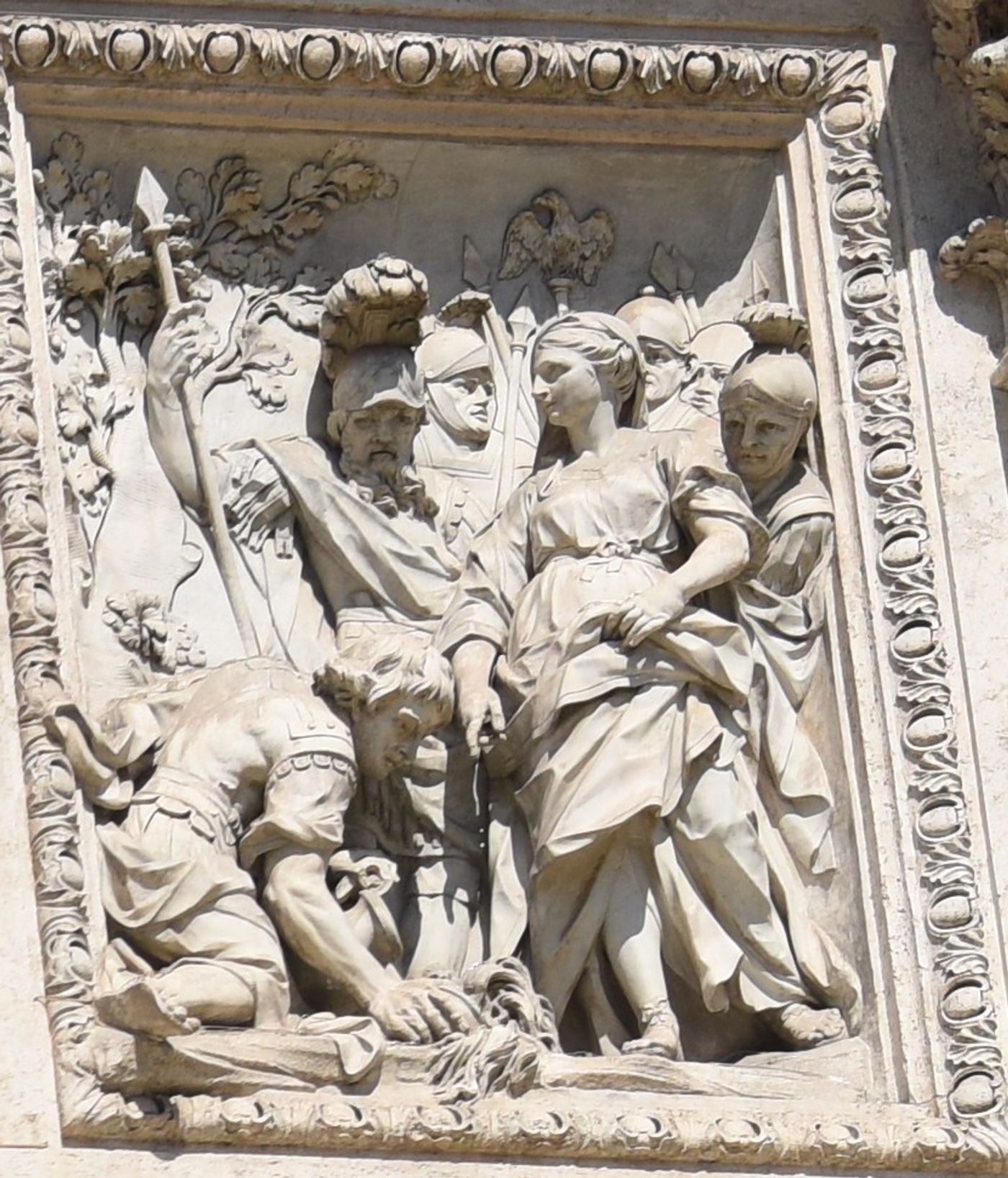
In 19 BC Marcus Vipsanius Agrippa, the Emperor Augustus’ most trusted ally and his son-in-law, needed additional water for his baths at the Pantheon, and sent out his soldiers in search of new springs for an aqueduct. Some miles east of Rome a young maiden pointed out multiple springs to them, which became the source for the Aqua Virgo, or “maiden water.”
The Goths destroyed the aqueducts in their siege of 537, but the largely underground Aqua Virgo survived. The waters of this aqueduct, which take some twenty-four hours to reach Rome, continued flowing all through the dark ages and medieval times. But they no longer reached the old baths, and most of the city’s fountains and twenty-four seven drinking troughs closed.
Until the middle of the fifteenth century, the aqueduct ended in a small pipe with three outlets that fell into three small basins below the Quirinale Hill, at the junction of three roads. The Renaissance Pope Nicolas V Perentucelli (1447-1455) restored the Aqua Virgo and had a new terminal placed in the Piazza dei Crociferi, to the left of the current fountain. He engaged the Renaissance architect Leon Battista Alberti (1404-1472) to create a simple oblong stone basin about the size of a swimming bath, into which the Trevi water flowed from the three openings, above this was a papal inscription with tiara and crossed keys.
The name “Trevi” came into common usage in Renaissance times—perhaps a name for the three mouths of the fountain, perhaps a reference to the three roads— “tre vie”—which met at the fountain. Or perhaps it was a reference to the town of Trebium, just east of Rome.
The restored Acqua Vergine (Italian) was for more than a millenium the only source of fresh water in the city. The small wall fountain of Alberti was to endure for almost two centuries.
Then in 1570 Gregory XIII Boncompagni (1572-1585) completely restored the aqueduct, which over the years had shortened in length due to poor maintenance near its source, and which had become polluted from the many holes in the line, and reconnected it to the original springs. Once again it was the best water in Rome.
When Sixtus V Peretti (1585-1590) brought the Acqua Felice with its Mostra of Moses and Paul V Borghese (1605-1621) brought the Acqua Paola and its Mostra Paola to Rome, the Trevi, still the source of the purest water in the city, looked out of place amidst all this new splendor. In 1640 the Barberini Urban VIII (1623-1644) engaged Gian Lorenzo Bernini (1598-1680) to make a new Fontana di Trevi. Bernini enlarged the square, and rotated the fountain ninety degrees, moving it out of the Piazza dei Crociferi, so that it now faced to the south. He planned to have the fountain seen and heard from the pope’s palace on the Quirinale, going so far as to pull down the buildings on the Quirinale that would obscure the pope’s sightlines.
Bernini then created a large double basin in place of the three small outlets of Nicolas V. Bernini’s work on the Trevi ground to a halt after the public protested the Pope’s permission for Bernini to use the stone from the tomb of Cecilia Metella. The delays that followed pushed Bernini to focus on other projects, and Urban’s death in 1644 and the election of the Pamphili Pope Innocent X (1644-1655) brought an end altogether to Bernini’s plans for the Trevi. The Trevi languished, now a large semi-circular basin with no decoration.
Clement XI Albani (1700-1721) wanted to take the column of Marcus Aurelius from the Piazza Colonna and place it on the Trevi, but on his death his successor Innocent XIII Conti (1721-1724) cancelled the plan, as his family, the Conti, dukes of Poli, had bought the buildings behind the Trevi for the purpose of constructing a huge Palazzo.
Clement XII Corsini (1730-1740) forged ahead with a plan by the noted architects Ferdinando Fuga (1699-1782) and Luigi Vanvitelli (1700-1773), who were joined by a very young architect named Nicola Salvi (1697-1751), then in his thirties, even though it entailed taking part of Palazzo Poli and enduring the complaints of the Conti. Salvi had attracted the pope’s attention with his recent design of a set-piece (machine) for a fireworks display in the Piazza di Spagna.
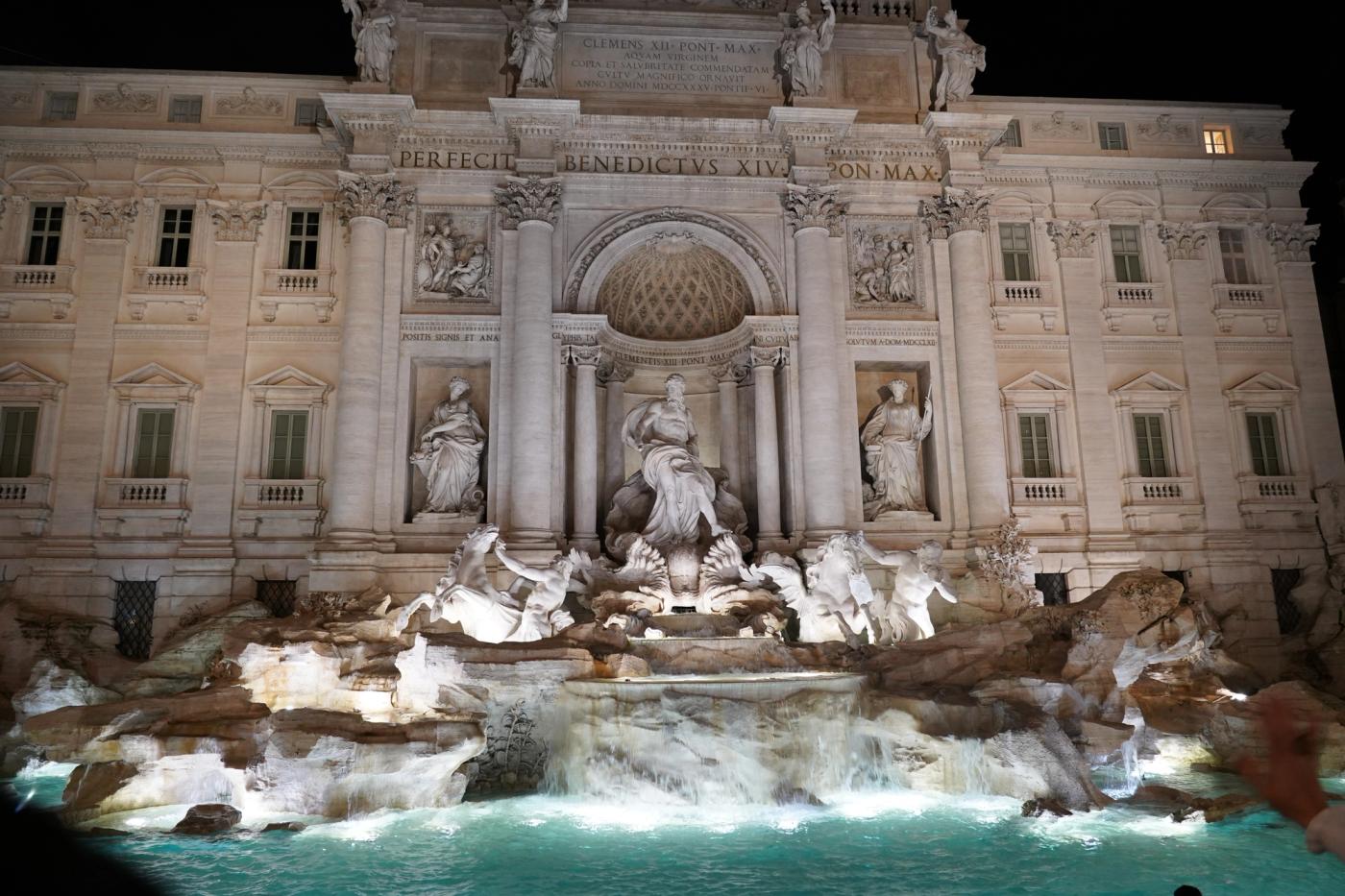
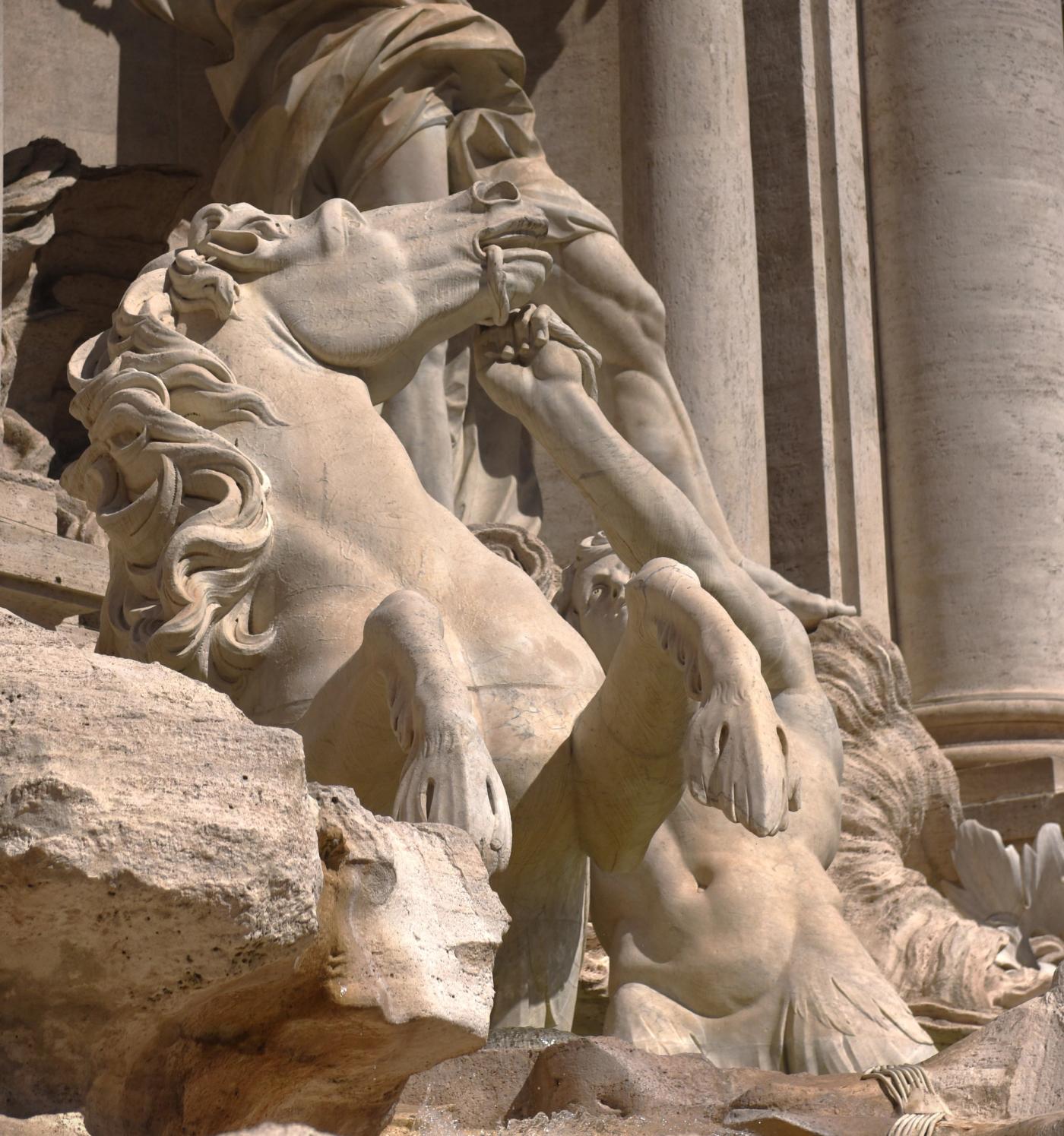
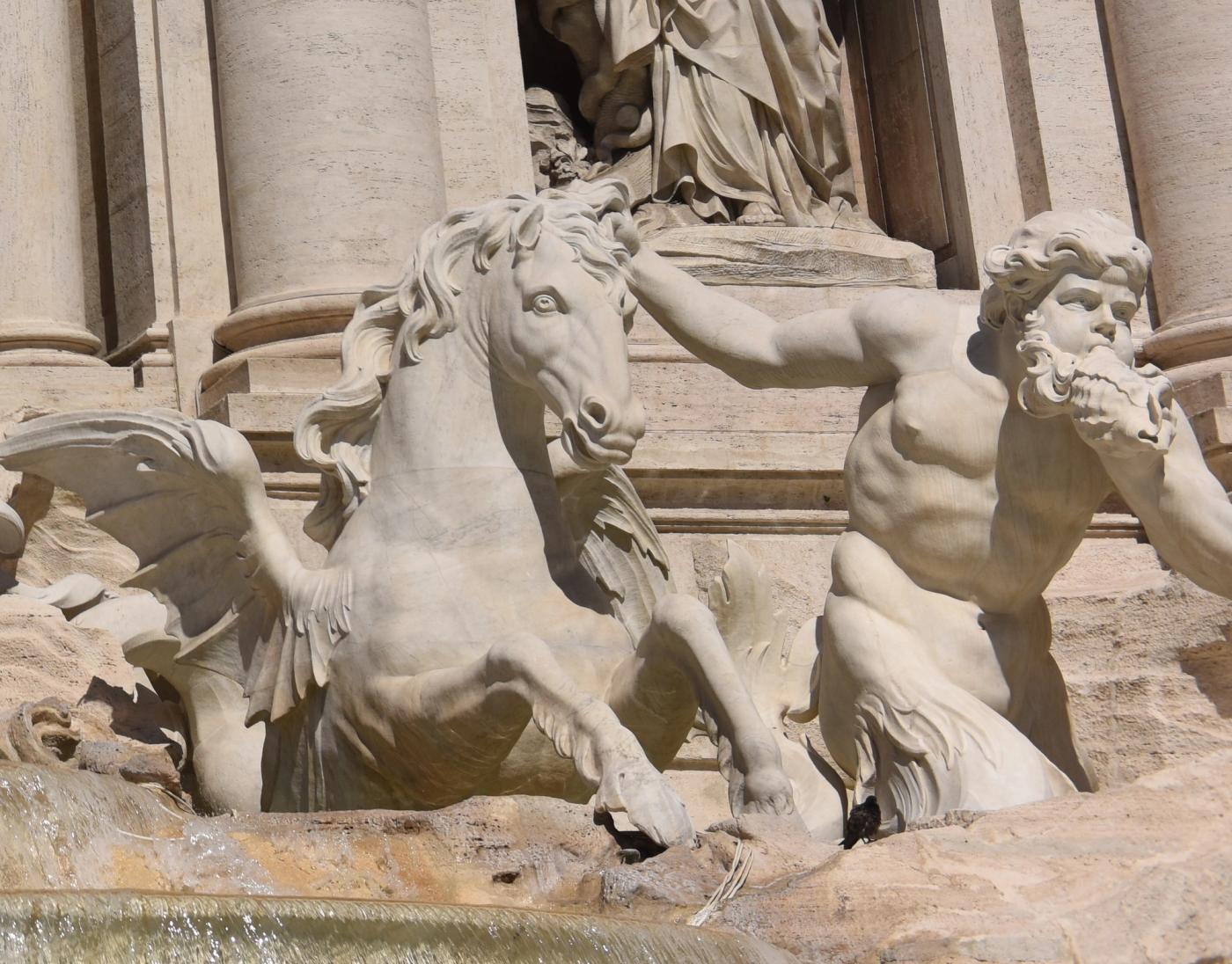
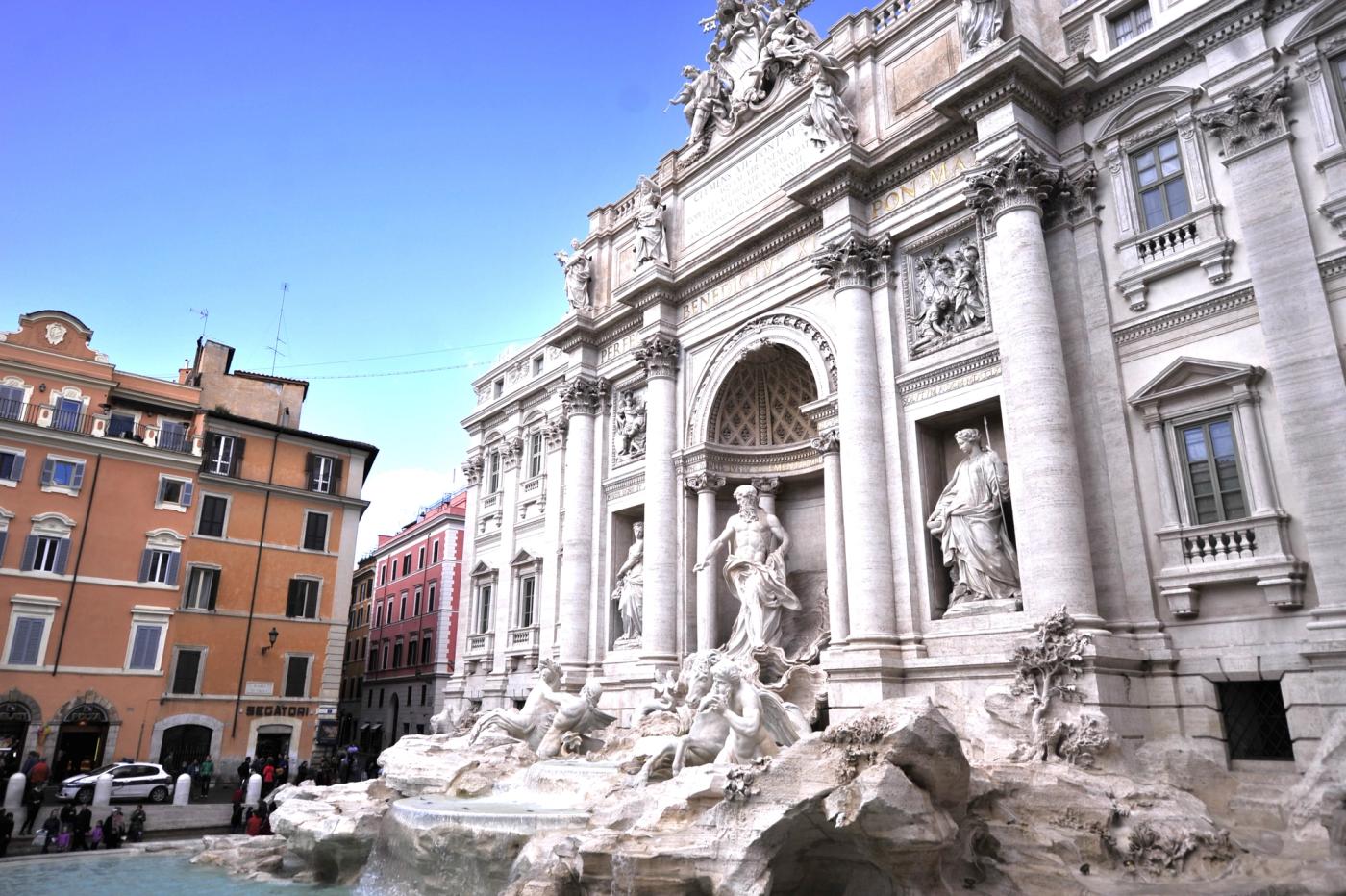
Salvi’s composition was intended as an essay on water. The Ocean God Neptune emerges from a column supported niche, placed within the side of the Poli Palazzo, in the middle of a reef that covers the entire lower part of the side of the Palazzo. Neptune is riding a shell-shaped chariot which is driven by two winged steeds, hippocampi, who are led by tritons.The horse on our right is known as the “restless” horse, the ocean in an angry mood, the one on our left the “tranquil” horse, the ocean at peace.
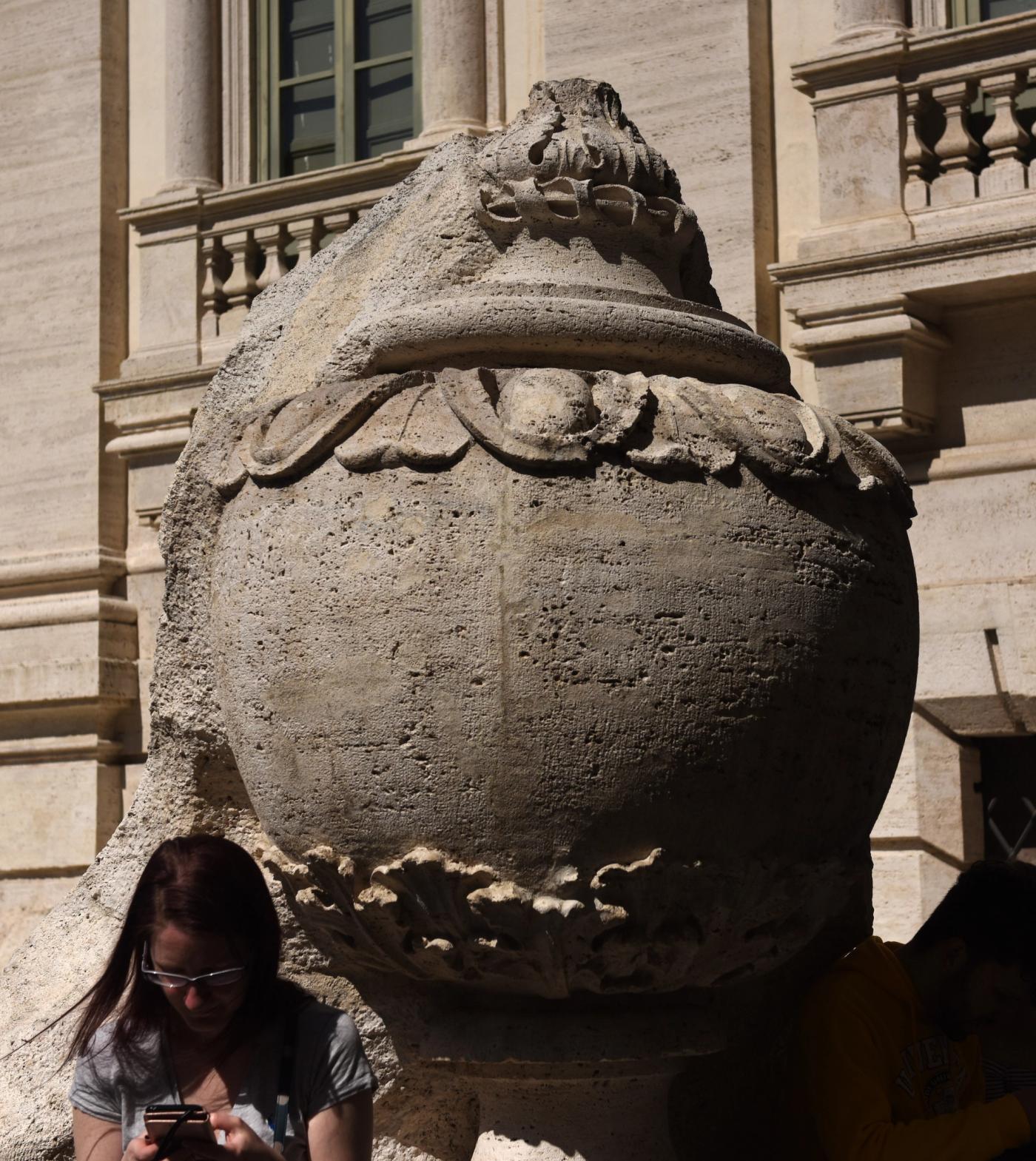
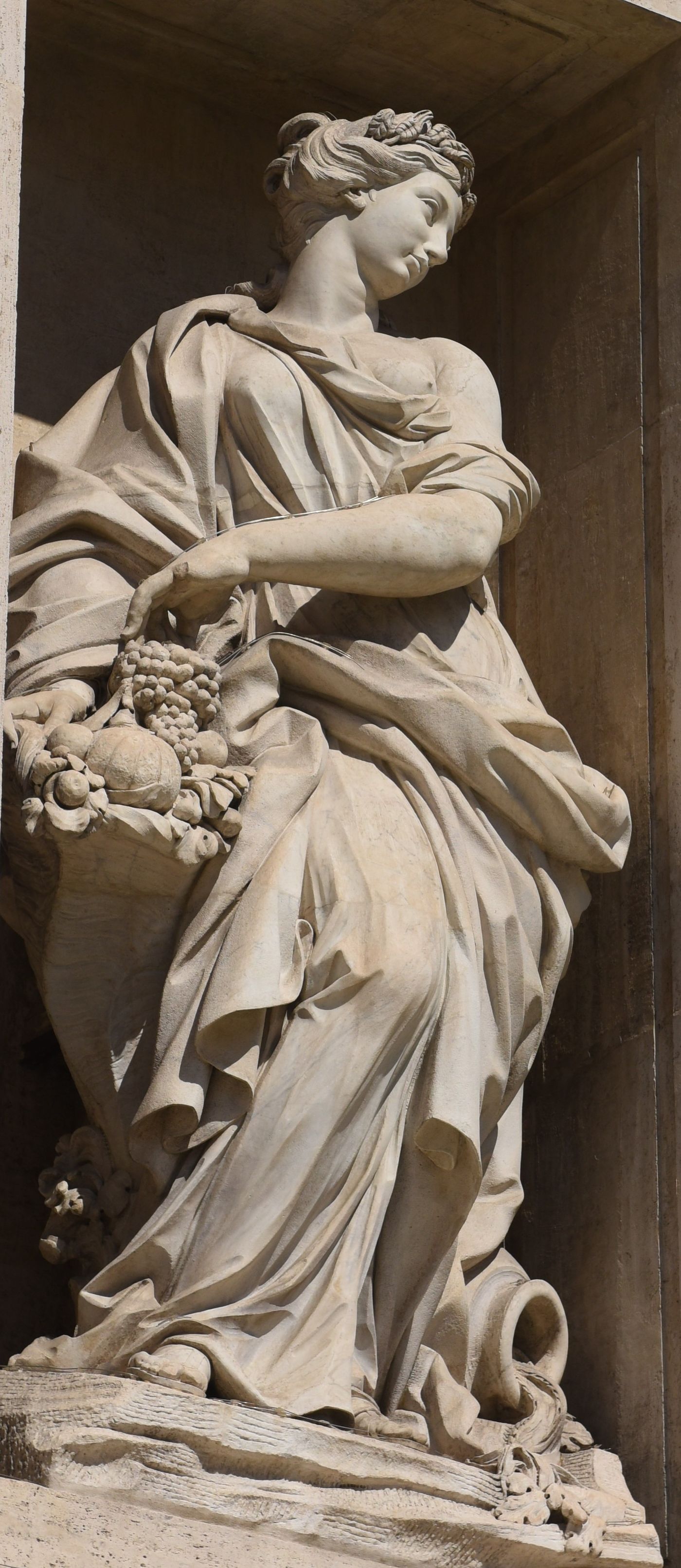
Salvi intended the urn wreathed in ivy on the right to represent the virtue of stored water; the tree and adjacent flowers were meant to represent life nourished by water. In its final form, statues of Abundance and Salubrity are in the rectangular niches. Above these are relief panels with Agrippa on the left approving his new aqueduct, and the maiden on the right showing Agrippa’s soldiers the springs.Four smaller statues known as the seasons are above: from the left: Abundance of Fruit, Fertility of the Fields, Richness of Autumn, and the Amenity of Gardens.
On Clement’s death in 1740 the Trevi was far from completion (it was to take 30 years).Benedict XIV Lambertini (1740-1758) was diligent in trying to complete the project. Salvi died, the legend is that he caught pneumonia in the culverts of the aqueduct.His successor was Giuseppe Pannini (1720-1810), who added the three basins below the Ocean’s shell, and also changed the subjects of the main side statues (the one that was originally Agrippa became Abundance). Giovanni Battista Maini (1690-1752) is responsible for the sculpture of the main group of the Ocean, although he died after making the model during the reign of Benedict XIV Lambertini (1740-1758). It was left to Clement XIII Rezzonico (1758-1769) to finally finish the Trevi on May 22, 1762. It was instantly famous, one of the new marvels of the world.
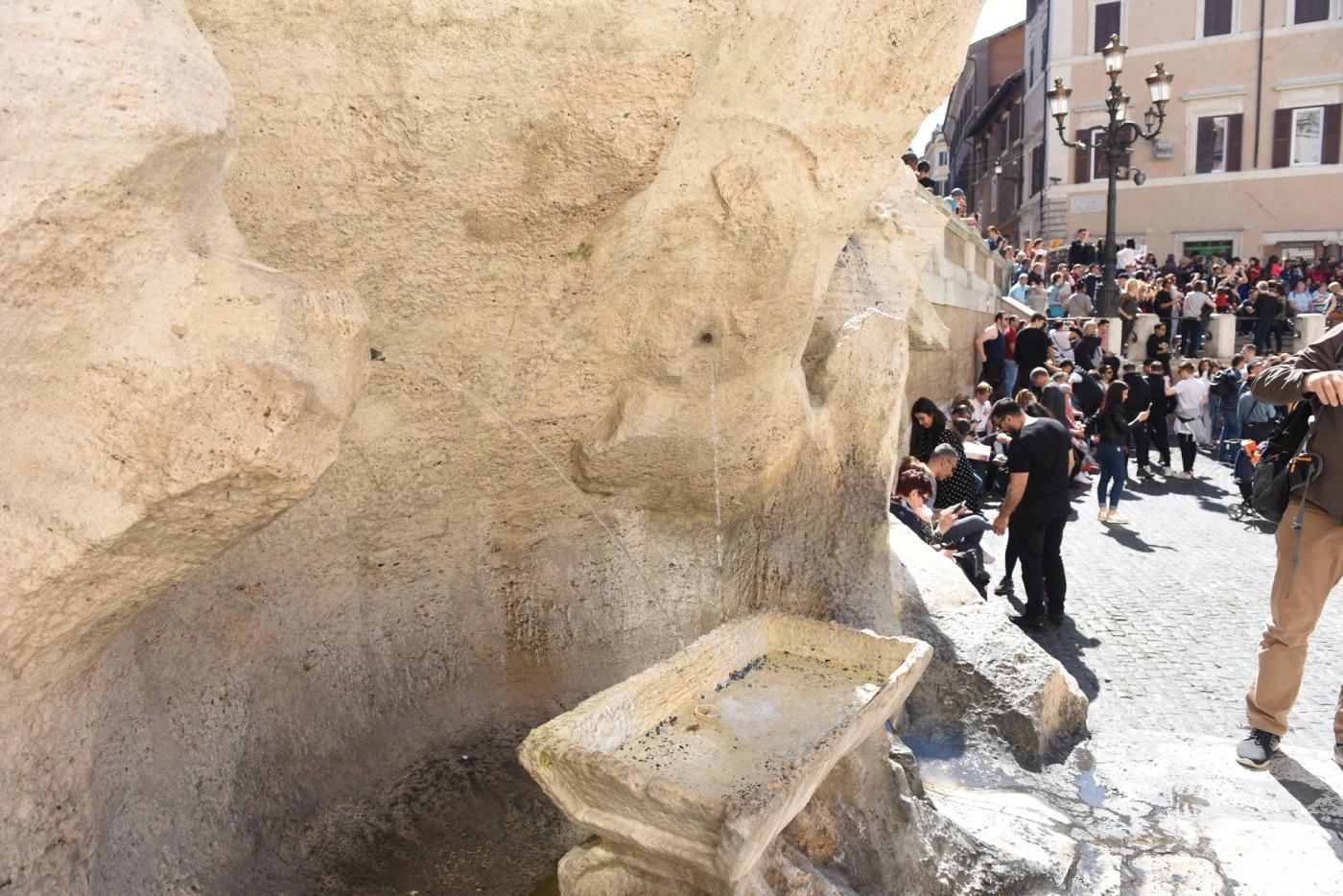
The oldest Trevi custom is to drink from the fountain with the left hand, then cast a coin into the fountain with the right hand, over the head. Today the Trevi water is not drinkable (non-potabile). A small drinking fountain fed by the Acqua Vergine Nuova is on the right, known as the Fontanina dei Fidanzi, for the custom of the newly engaged: if one of them was leaving Rome, the couple came to the fountain, took a drink from the fontanella and dashed the glass on the rocks, to ensure a safe return.
Thank you for reading. If you found this useful, you might also enjoy the books.